Part I: Talking Maths
Q: What are the platonic solids and why are they an important part of the language of math?
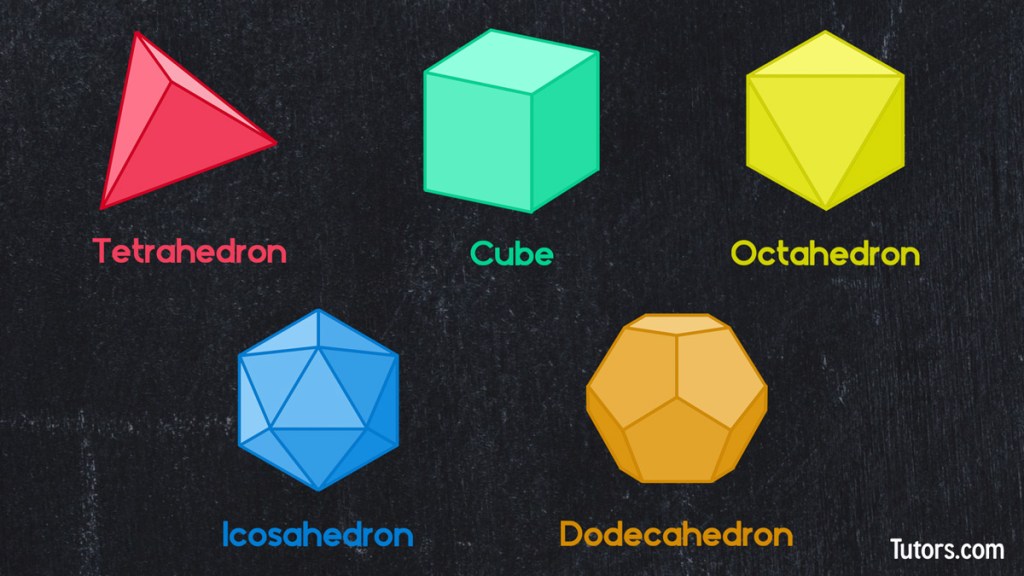
Platonic Solids (named after the ancient Greek philosopher, Plato) are regular polyhedrons in a three-dimensional space, with equivalent faces made of congruent (identical, convex (all edge’s point outwards) regular polygonal faces.
Plato proposed “the theory of everything” in which he hypothesised that each of the platonic solids represent an element (air, water, fire, earth, and the universe). He thinks that when these solids are cut up (similar concept to subatomic particles such as electrons or quarks today), they can merge together to form another element . For example 5 fire coming together to form 1 water.
P.S if you’re really interested in how it works: https://outsidethehexahedron.wordpress.com/2018/07/31/platonic-solids-and-a-theory-of-everything/
Despite Plato’s idea being mostly incorrect, his idea made people to think differently. He thinks that small, fundamental particles in nature have different shapes and properties compared to things they make up. This is proven by particle physics today, where electrons and quarks behave completely differently to the things we see around us.
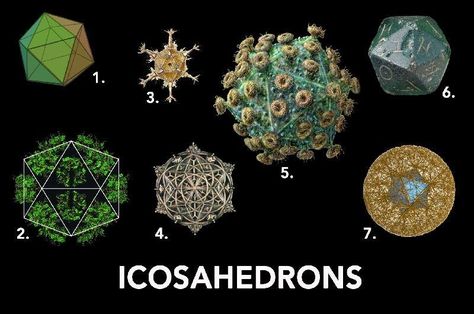
Platonic solids also provide great ideas about symmetry. It explains the concept of string theory (physics), a model which tries to combine gravitation, electromagnetism, strong nuclear force, weak nuclear force together in one theory. In addition to that, we can actually find these platonic solids literally EVERYWHERE. Diamond, an allotrope of carbon, has the shape of an icosahedron. Many microorganisms such as algae are also in the shape of platonic solids.
Don’t know what i just typed lmao. Hopefully the next part will make more sense
Part II: ❤️ vs 🧠
Q: To what extend do instinct and reason create knowledge?

As living things, we all possess instincts or automatic, subconscious natural reactions. What gives us humans the edge in this world is the fact that we also have the ability to do analytical thinking – a slow, logical and conscious reasoning. Instinct is a faster way to create knowledge, but being affected by emotion, culture, and perspective, it can be often incorrect and misguide us into making the wrong decisions. Experiencing many different scenarios creates a database in our brains which we use for analytical thinking. This is where the famous “The older, the wiser” idea comes in. The older you are, the more experienced you are. Therefore, unlike inexperienced youngsters, older people tend to use their logical reasoning instead of instincts.
Instinct generally only works when the current situation resembles a past situation. As a result, people usually feel more confident pushing through with their analysis if it is backed up by reason. This is because intuition can have confirmation bias, in-attentional bias, hindsight bias and many more weaknesses. Confirmation bias is when we tend to notice and interpret things in terms of what we’re already familiar with. A famous example is the Monty Hall Problem:
- There are 3 doors, behind which are two goats and a car.
- You pick a door (call it door A). You’re hoping for the car of course.
- Monty Hall, the game show host, examines the other doors (B & C) and opens one with a goat. (If both doors have goats, he picks randomly.)

Here’s the game: Do you stick with door A (original guess) or switch to the unopened door? Does it matter?
Surprisingly, the probability isn’t 50-50. If you switch doors you’ll win 2/3 of the time! It’s hard to wrap your head around this concept. Personally I didn’t agree to this statement until i became the “host”. Try it for yourself!
Reason as a Way of Knowing carries high status in knowledge production, application and validation. German philosopher Immanuel Kant says that reason is the most important and final stage of knowledge creation. Although there are a lot of arguments regarding this statement, growing up as students, we have been taught that to give valid arguments in science, maths and other subjects we learnt in school, we cannot simply use our intuition, our faith, etc. It’s reason that needs to be present for our arguments to be sound and valid. This kind of logical reasoning will act as a filter for potential weaknesses of other WoK such as intuition (often inaccurate).
Despite having the option of using either instinct or reason, here are several reasons why people would still choose to use instincts over reason:
- You really don’t know the answer (ambiguity in data)
- You don’t have enough time to think about it logically
- You are generally spontaneous
- Your instincts helped you more than using reason in past situations
Instincts and Reason both play a role in helping an individual gain knowledge. Generally, people use intuition to come up with the initial idea that would later on lead to the knowledge. Then they use reason to back up their findings. When they reach a dead end, most people would turn back to intuition. However each and every individual depend on these to methods to different extends. Unlike what most people think, it’s not necessarily bad to use your heart more than your brain. It is important to note that they both can be helpful in different situations.
Which one do you use more? Drop it down in the comments below! XD
Part III
What is Euclidean Geometry?
We all learnt geometry in school and that type of geometry is known as Euclidean geometry. Euclidean geometry, which was found by a Greek mathematician Euclid, is the study of the geometry in flat two-dimensional surfaces. Euclid’s Postulates (several things that apply to plane Euclidean geometry) are as follows:
1. A straight line segment can be drawn joining any two points.
2. Any straight line segment can be extended indefinitely in a straight line.
3. Given any straight line segment, a circle can be drawn having the segment as radius and one endpoint as center.
4. All right angles are congruent.
5. If two lines are drawn which intersect a third in such a way that the sum of the inner angles on one side is less than two right angles, then the two lines inevitably must intersect each other on that side if extended far enough. This postulate is equivalent to what is known as the parallel postulate.
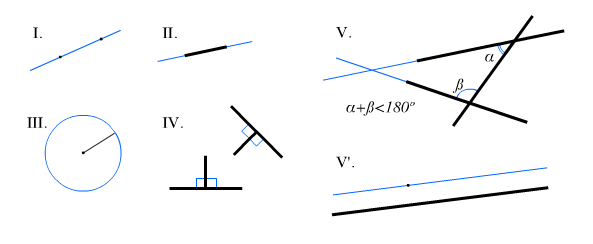
However, the fifth postulate was falsified using the theory of non-euclidean geometry.
What Is Non-Euclidean Geometry?
Most things are not two-dimensional. Even a piece of paper, although seems like it’s two-dimensional, is actually three-dimensional. The laws of Euclidean Geometry doesn’t work in this case. For example “The interior angles of a triangle add up to 180°”. When you draw a triangle on a sphere, the sum of the interior angles is greater than 180° . (This will be proven in below)
Do different Geometries (Euclidean and non-Euclidean) refer or describe different worlds?
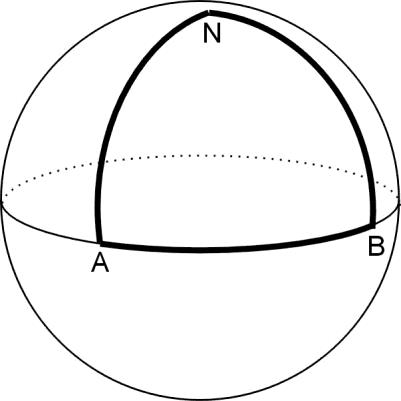
Yes. In the world we live in, we most of the things we experience doesn’t align with the rules that apply to euclidean geometry.
Imagine starting at the north pole and walking down to the equator (towards A) . Then walk to the east until you’ve traveled 1/4 of the circumference of the earth (towards B) then head north back to the North Pole (towards N). Think about it. All you’ve done is turn at right angles but you’ve made a triangle with your path. So the interior of the triangle adds up to 270°!
Another thing is that path N to A and B to N are supposed to be parallel lines because they run the North-South direction. But how come they both intersect the North-Pole?
Part IV: Taking Credit
Q: Is it ethical that Pythagoras gave his name to a theorem that may not have been his own creation?
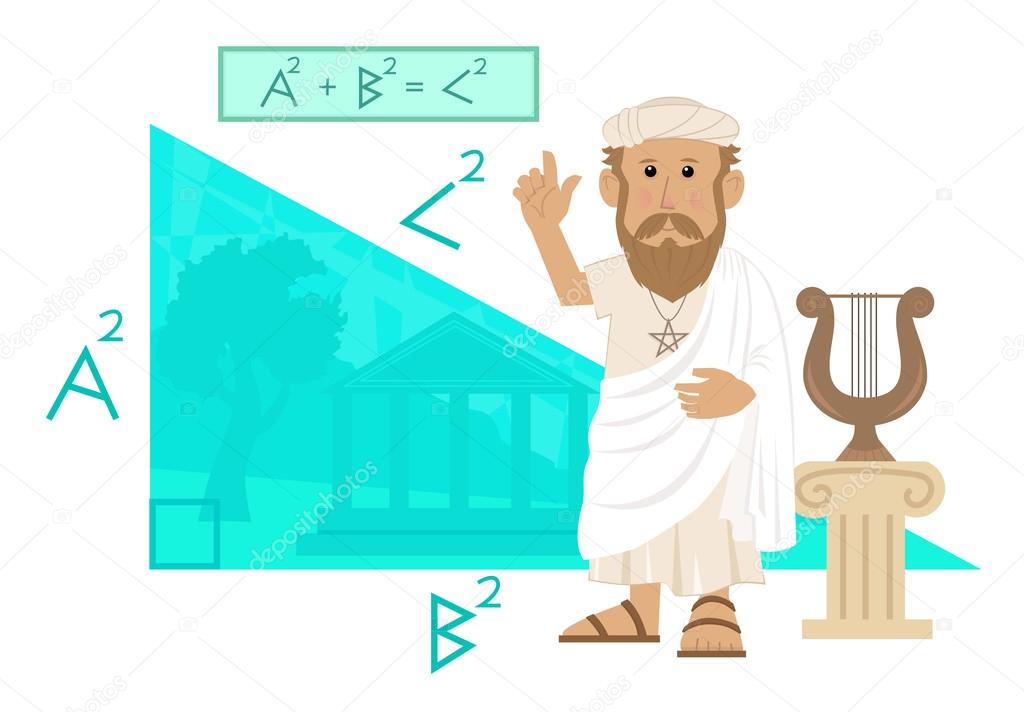
There are some evidence that the Pythagorean Theorem wasn’t first found by Pythagoras himself. Plimpton 322, a Babylonian mathematical tablet dated back to 1900 B.C., contained a table of Pythagorean triples. The Chou-pei, an ancient Chinese text, also proves that the Chinese knew about the Pythagorean theorem before Pythagoras. The Baudhayana Sulba-sutra of India, which was written between 800 and 400 BCE also mentioned the theorem.
So is it ethical that Pythagoras gave his name to a theorem that may not have been his own creation? No, I don’t think it is. Claiming someone else’s work as your own is just morally wrong. Some people argue that if Pythagoras didn’t label the theorem, it could easily be forgotten and also if everyone who contributed were to be credited, there will be way too many people. If that’s the case though, i think that they should name the theorem after something else, anything but people’s names.
Arguing for Pythagoras, we can say that the absence of technology at that time meant that Pythagoras probably thought that he was the first person to discover it. It’s only recently that they found all these other evidence that proved he wasn’t actually the first person to know about this theorem. Another possibility is that Pythagoras didn’t actually go around telling people that he was the first person to discover it or that everyone has to call it the Pythagorean Theorem. People may have just referred to it that way because they learnt it from him and it just so happen that everyone eventually gave his name to this theorem.
Sources:
https://www.trido.uk/single-post/2018/04/19/Platonic-solids-history-uses-and-applications
https://www.quickanddirtytips.com/education/math/what-are-euclidean-and-non-euclidean-geometry
https://study.com/academy/lesson/differences-between-euclidean-non-euclidean-geometry.html
http://mathworld.wolfram.com/EuclidsPostulates.html
https://betterexplained.com/articles/understanding-the-monty-hall-problem/
 Helen's Blog ᕕ( ᐛ )ᕗ
Well said! This blog is indeed a great addition to wordpress community. My mind is full of new insights.
Keep it up Helen 🙂
LikeLiked by 1 person